
Gandalf and Harry Potter
Contemplative Priest vs. Technocratic Magician

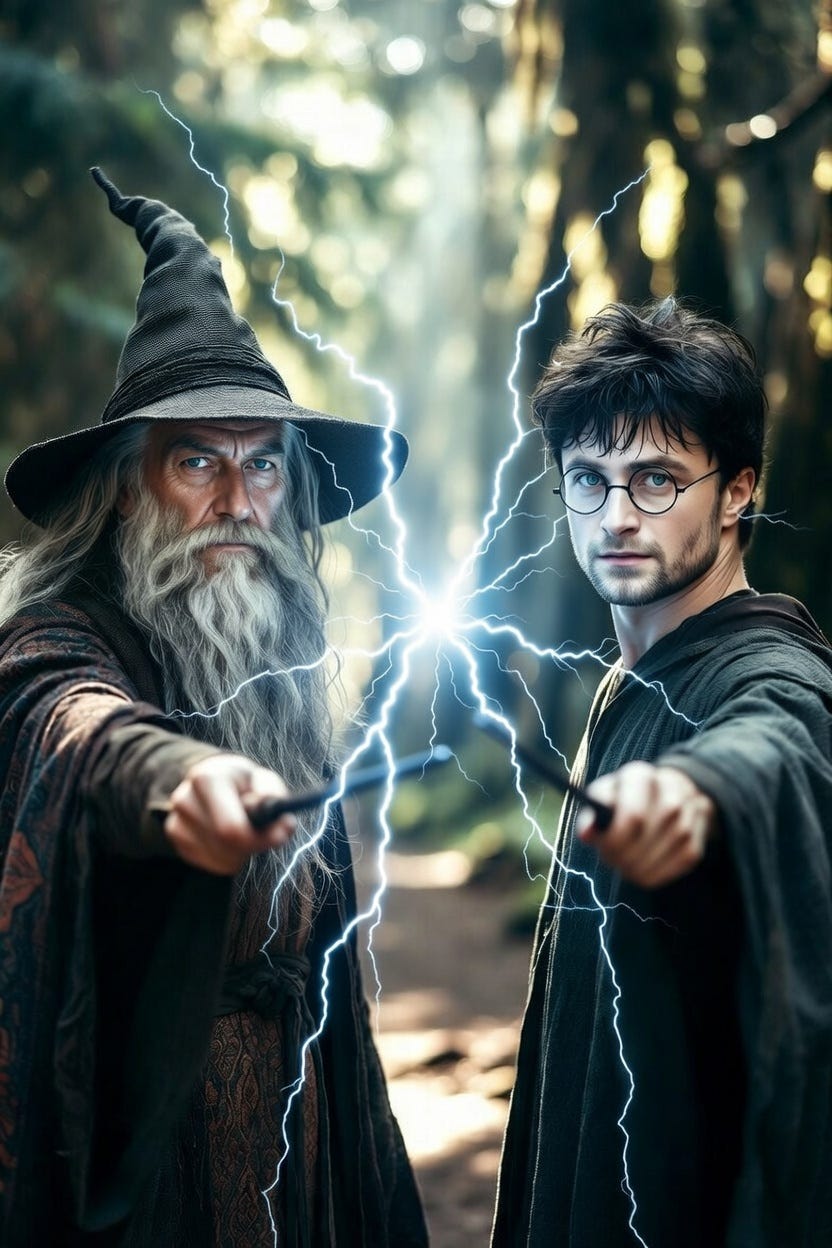
I have always had a problem with Harry Potter. I’ve enjoyed watching the movies, and we let our children read the books (once they mature enough). I can’t find the time to read the books myself, but my wife says they’re well written, and she knows what she’s talking about. Besides the blurring of the lines between Good and Evil (I’d argue that witches are inherently bad—no such thing as a good witch, sorry Frank Baum!), the Harry Potter books have a Technocratic view of magic. I’ve long argued that Tolkien’s Gandalf is a demonstrates a better example of the use of “magic.” This should not be surprising, since Tolkien was a Catholic Christian anchored in what C.S. Lewis called “Old Western Culture” and J.K. Rowling is a confused (though searching) post-Christian. A recent article gave me words to better express the difference: Gandalf is a Contemplative Priest, while Harry Potter is a Technocratic Magician.
In his article over at Touchstone, “The Priest & The Magician” Nicholas Ziegenhagen argues persuasively that the atheistic/materialist pursuit of Technology is really a form of Magic. Conversely, Magic was an earlier form of Technology. Both are attempts to gain control over, and manipulate, the natural world. Zigenhagen develops an insight of Eduard Spranger, commenting:
“Magic is the primitive threshold of technology.” That might seem like a big jump at first, but Spranger is showing us how magic and technology are different means to the same end. They differ only in the method they employ to achieve that end. Magic is inherently a technique to activate invisible powers or forces in the service of man, with or without that pesky Ashtoreth’s or Dagan’s approval. Magic—and this is key—is inherently a “technique of power.”
Spranger contrasts this magical will to power with what he calls an attitude of contemplation towards the world. The attitude of contemplation implies a certain acceptance of the givenness of things, a certain resignation to divine providence. Above all, this attitude of contemplation implies a posture towards the world of humility and wonder. Knowledge, for the one who contemplates, is a way of loving the world around him, of receiving and wisely stewarding the world as intended by God. This contemplative attitude, which is nurtured by religious faith and observance, is the opposite of the attitude of the magician. We might call it the priestly attitude.
In Harry Potter, magic is simply a “technique.” It is a way to get things done more easily. There is nothing too small or insignificant, or silly, for magic. Although young wizards and witches have to go to school to learn magic, the classes are really just how-to classes. Not really different than a car repair class: this is how spells work. This is how to get things done more easily and efficiently. Just say a few Latin-sounding words, and poof! There is little discussion of teleology, or the purpose of magic. Of course, there are good and bad guys. That’s what redeems the stories at all. But magic is neutral. It is a technique, a way to wield control, that can be used for good or evil. It just depends on the person.
Contrast this with Gandalf. According to The Silmarillion, Gandalf and the other wizards are Istari, angel-like figures who are sent to help guide history and to oppose the powers of darkness. What is remarkable is that, compared to Harry Potter, Gandalf is positively stingy with his magic. He rarely uses it! When he does, there’s no mistaking his power and moral authority. But, most of the time, Gandalf relies on words—counsel, wisdom, encouragement, and harsh rebuke when necessary. He does not simply wave a wand to make things easier. He has to puzzle over the right spell at the door to the mines of Moria.
In Tolkien’s world, “magic” is more of a deep understanding of the nature of reality. It is not a technique—it is using forces, or powers of nature, or of the forces underlying nature, in a certain way. It can be used for evil (Sauron), but Sauron’s use of magic is also limited. It is understated, present in the background, and more mysterious. In Harry Potter, magic is too easy. In Tolkien, magic requires wisdom.
The best example of this in Tolkien is Tom Bombadil. As one of the oldest (if not the oldest) creature in Middle Earth, Tom knows the deepest secrets of nature. But, he is so wise because he is so innocent. He is so young because he is so old. He is so powerful that the Ring of Power has no power over him. He just doesn’t care, because he’s in touch with the deepest realities of nature and creation. In that sense, the ring of power is more like Harry Potter technique—designed to simply get something done. It is a tool to control others. Tom Bombadil has no use for mere Technique. He is the ultimate priest and contemplative in Tolkien.
None of this should be taken to imply that the Harry Potter books are worthless. Perhaps some readers will correct my perception of them. Perhaps the Harry Potter movies leave out Rowling’s deeper portrayals of magic. Like I said, I’m basing my critique solely on the films. Speaking of films, Peter Jackson falls prey to Magic as Technique as well, making Gandalf do more magic Harry Potter-style than in the original books. What else would we expect from a director in the Technocratic age?
Enjoy Harry Potter. But go deeper with Tolkien. Learn from the contemplative Gandalf. Reject the temptation to wave any sort of magical “wand” simply to get results. (What would Tolkien say about AI?!). Recommit yourself to reading and using words of wisdom. Reject the temptation of mere Technique. And feast like a Hobbit!
[Note, I wrote this post after reading only the beginning of “The Priest & The Magician” by Nicholas Ziegenhagen. I just finished the article and discovered that he also discusses Tolkien and Gandalf! What was that saying about great minds? … He also brings in Saruman and develops the theme of hobbit-resistance, so head on over and read his piece!]
Here's a thought experiment: Abraham & Isaac & the [Substituted] Ram/Lamb. Sounds pretty Miraculous to me. What do we think of THIS kind of "Magic"--where God/Angel/Star/etc. take the place in our experiment for "technique" or "wisdom"? Miracles seem pretty much like "Magic" to me, except the Agent is categorically different, or have I got things crashed together again :-)