
Things Glorious & Things Ruinous: Considering Classical Education Amidst Cultural Decay
Book Review

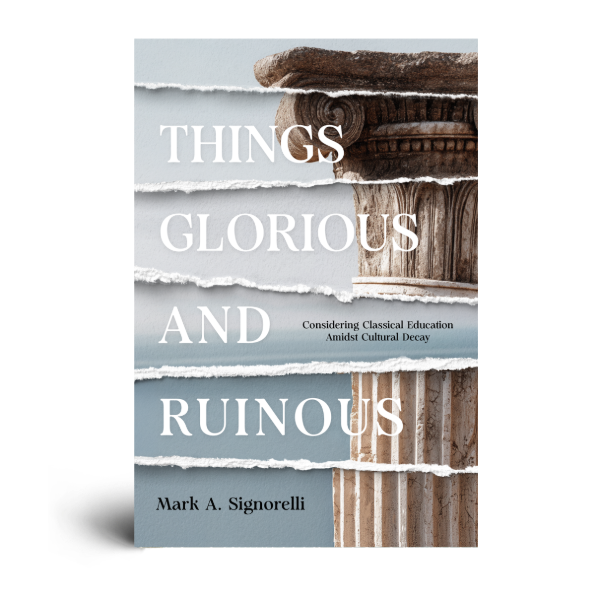
I love teaching. It’s my calling. After 20+ years in the trenches, I have no regrets, although I could have made a lot more money in another career. I have been able to be part of the training and discipleship of hundreds of students over the years. So many of them are now doing amazing things and extending the Kingdom of Christ into every corner of the world. But … I really enjoy Summer. Time to reset. Refresh. Plan for next year. What can I do better? There are so many ways to keep growing and developing my craft. Teaching is hard work. Summer is a time to replenish the resevervoirs of my own learning, and joy in learning, so I will be able to overflow into the lives of my students in the Fall. Every teacher needs some Summer reading to inspire them to take up the mantle once again. In a recent Summer, Josh Gibbs’s Something They Will Not Forget got me charged up. (If you haven’t read it, go get it now!) This Summer, let me recommend Mark Anthony Signorelli’s Things Glorious & Things Ruinous: Considering Classical Education Amidst Cultural Decay.
This is a beautiful book. The design and paper type show clear concern for excellence from CiRCE, the publisher. It’s also beautifully written. Signorelli has a background in literature and it shows. I found myself needing to look up words I didn’t know more than once. But the book is not dry, pedantic, or overly academic. Signorelli obviously delights in words, and helps up to do so as well. The author has extensive background in teaching and administration, both in public and classical schools. He combines trenchant analysis of our current educational and cultural breakdown, while reminding us of the true goals of a classical education, bringing the treasures of the past in application to the woes of the present.
Part 1 is devoted to Theoria: The Idea of Classical Education and Part 2 to The Liberal Arts Tradition Today. Part 3 discusses Classical Education and Child Development, while Part 4 treats the Place of the Classical School in Society. Part 5 considers Classical Pedagogy and Part 6 ends with Classical Approaches to Writing Instruction.
Signorelli’s essays are a balanced mixture of theory and practice. He draws deeply on the wells of the classical tradition, modeling how to interact with sources in the Tradition. However, his treatment is never purely theortical, returning often to the practical application of the broad principles. Here are some of the gems you’ll find in this book:
“Modern education prepares students for the workplace. Classical education prepares them for life” (4).
“It is finally in terms of that satisfactoriness, or fittingness, that classical educators find the justification for their chosen approach to the task of teaching children. Others may boast that their curricula best prepare young people to compete in a global marketplace or to ‘become the change they want to see in the world.’ The classical educator only claims to offer her students the right kind of encounter with being for the kind of beings they are. She only says that her program of study brings children into regular contact with truth, goodness, and beauty because children desire, above all things, truth, goodness, and beauty” (13).
“The modern education system, with its stupid and unhealthy obsession with testing metrics, constantly requires young people to demonstrate what they can give. But the classical school only asks the student to show up ready to receive. This emphasis on the students’ receptivity has one obvious corollary, which is that young people of highly differing aptitudes can benefit from this kind of course of study. If the significant thing is not what students bring to their studies but what they can take away, then a considerable disparity in talents can be accommodated in classrooms where engagement is prioritized above all things” (32).
On teaching children about the injustices of the past: “The only possible justification for teaching young minds about the horrid injustice that men have inflicted upon one another is to awaken them to an awareness of their own potential to carry out such injustices and to begin to cultivate in their souls some resistance to that propensity. By classifying whole sections of the public as the victims of history, we actively prevent the youth belonging to those sections from arriving at such awareness and insinuate into their minds a reflexive conviction in their own incapacity for injustice. The self-righteous violence that so many of our youth now readily resort to is perfect evidence of just how morally corrupting this mode of education can be” (70).
Preparing the Next Generation of Elites - “Classical educators need to explicitly acknowledge their responsibility for providing the next generation of political and cultural leadership with the formation in virtue that alone qualifies a young person for eventual preeminence” (135).
Education & Politics - “We do not sufficiently consider the extent to which many, if not most, of our political ills have their roots in the deficiences of our educational system. We do not think enough about the way the failures of our leadership class have resulted from the poverty of the schooling they have received … It follows that any real efforts of political reform must encompass a program of educational reform and that such a program must aim to reestablish training in the old humanistic curriculum as the basis for entry into public life. Until we have leaders whose minds and characters have been formed by that kind of curriculum, we will continue to watch our public affairs degraded by those who think they possess real knowledge but in reality only possess its simulacrum” (139).
The book is full of similar quotables, but I hope that’s enough to whet your appetite and motivate you to go purchase it right now!
My main critique is that Signorelli does not more fully develop the Christian, or theological, foundations and applications of classical education. There are sporadic references to the Bible, theology, and Christianity, but that is icing on the cake, rather than the firm foundation of the edifice. My guess is that Signorelli is writing to, and for, the broader revival of “classical” education, which is not always explicitly “Christian.” I think this is a mistake. Attempting to remove Christ from history, or the influence of Christianity from classical education, or even Western civilization, is like attempting to remove the pedastal on which the Statue of Liberty stands. Through common grace, and mankind’s shared nature as made imago dei, pagans and unbelievers may discover many important truths. However, without a knowledge of Jesus Christ, the λογος, the arche, the very integration point of all reality (John 1; Colossians 1:17), they will stumble endlessly in a cave on unknowing.
Another annoyance was the ever-so-politically-correct sporadic use of “she” or “her.” I’m not a male chauvistic pig, and I fully grant that girls and women can and should be educated and participate in the highest levels of scholarship. However, the lies of Feminism are one of the central deceptions of our time. To give in here, or to seek to mollify the critics of Western civilization and Christendom by throwing them a bone or two, betrays a failure of nerve. “Mankind” is still an important term. “He” has always been understood to include the female sex. This kow-towing to the culural zeitgeist in unnecessary at best and insidious at worst.
That said, this is still a fantastic book. Every teacher, parent, administrator (and even upper level students) should read it. If you’re not currently involved the grand and glorious work of classical Christian education, this book will motivate you to join us! If you already are, it will encourage you to persevere, knowing that you are sowing seeds that will generate a bountiful harvest, both in this world, and the world to come.
(Note: I received a complimentary review copy of this book from the publisher, without any promise or expecation of a positive review).