
Let the Liturgical Year Set the Pace
After Christmas, Now What?

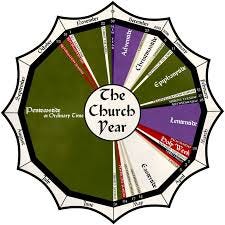
Happy 12th Day of Christmas! Here are some reflections on the importance of the church year, along with some reposts of thoughts informed by Martin Luther on how the Christmas “spirit” should not just be confined to the Christmas holidays. (Thanks to Dr. Uriesou Brito and Lydia Slaughter for the church year graphic.)
“Let the Liturgical Year Set the Pace”
Dr. George Grant and I published this recently: “Entering a new year, the question we should be asking is not whether our lives will be controlled by a calendar. The real question is this: Whose calendar will govern our lives? The historic liturgical church year can help us to pace ourselves for the long haul. The church in history provided designated seasons of meditation on God’s mercy, grace, truth, and justice. How? Consider a few of its rhythms this calendar year …”
Read the rest over at Common Good magazine!
“Whence the Christmas Spirit?”
“In a sermon for Christmas Day, published in the 1500s, this former monk reminds us that the true “Christmas spirit” should last all year long. Jesus was the second person of the Trinity. As the Son of God, he became man, and was born into human history, to make atonement for sin and to inject the life-giving Spirit (the third person of the Trinity) into all of humanity as the Holy Spirit works through every Christian. The birth of Jesus Christ was the beginning of a series of events that would transform the world by bringing into it the Kingdom of God. We have the privilege of participating in this process. For Luther, we don’t really understand Christmas if we don’t care for the poor and love our neighbor as ourselves–all year long!”
Read the rest over at SALVO magazine!
“Martin Luther, Christmas, and the Poor”
“Martin Luther’s teachings on social responsibility and the effects of the Gospel on culture have suffered misrepresentation by scholars. Carter Linberg claims this is due mostly to Ernst Troeltsch’s misinterpretation of Luther in his massively influential The Social Teaching of the Christian Churches (1912). Troeltsch’s skewed take on Luther was propagated by Reinhold Niebuhr (Carter Lindberg, Beyond Charity, 161). But Luther was keenly aware of social issues and especially the issue of poverty. In his sermons for the Sundays in Advent, Luther stridently claims that charity must characterize the Christian life throughout the year, and not just at Christmas. He argues that faith without works is dead, and presents our care for the poor as the prime test case of whether we have true faith or not …” (Read the rest here).
Prayer for the Second Sunday after Christmas Day
“O God, who didst wonderfully create, and yet more wonderfully restore, the dignity of human nature: Grant that we may share the divine life of him who humbled himself to share our humanity, thy Son Jesus Christ; who liveth and reigneth with thee, in the unity of the Holy Spirit, one God, for ever and ever. Amen.” (Book of Common Prayer)
Thanks for reading!